Zero-emission buildings: the clock has already started
The European directive on the energy performance of buildings leaves «nearly zero-energy» behind. From 2028 new public buildings must be zero-emission, and from 2030 all of them. Spain is already processing the changes: here is what you need to know to design today without falling behind tomorrow.
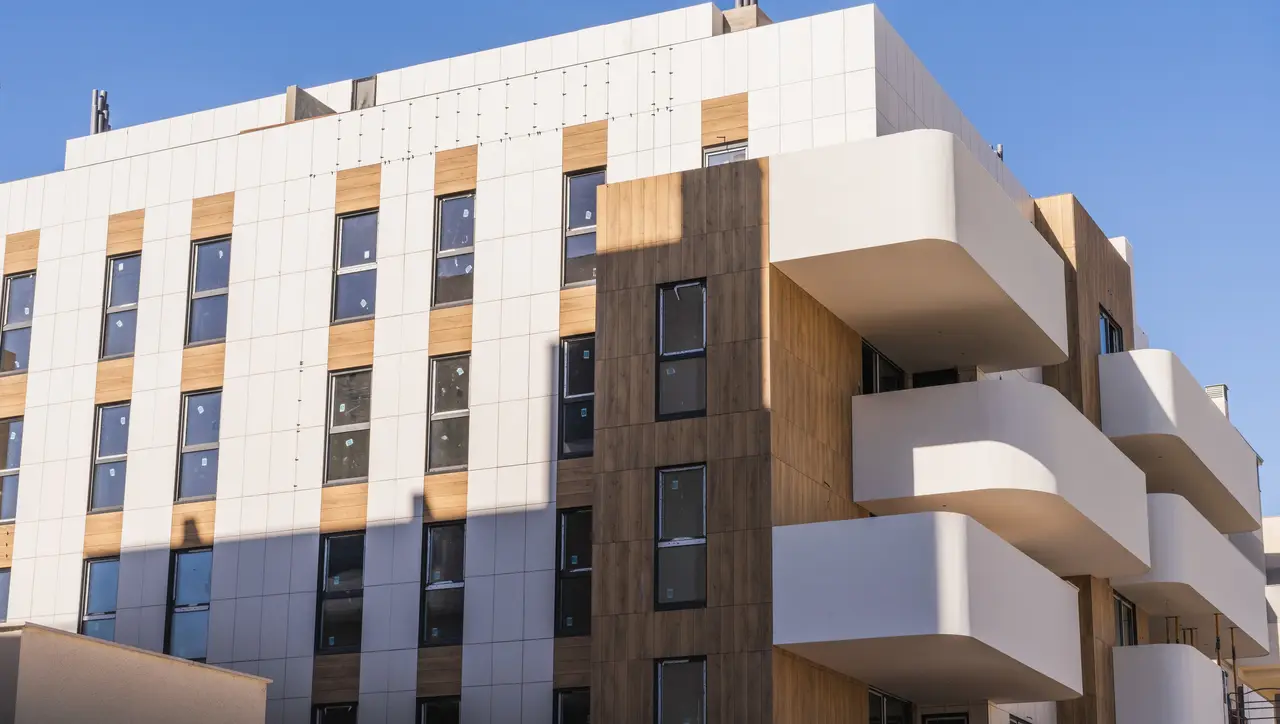
Passiv-Imaginalia (Albacete): the first Passivhaus-certified apartment block in Castilla-La Mancha. Designed by Ingeteo.
Key figures
2028New public buildings, zero-emission
2030All new buildings, zero-emission
≥10%Lower maximum demand than today's «nearly zero» threshold
16%Worst non-residential buildings to improve before 2030
For more than fifteen years, the benchmark for designing buildings in Europe has been the nearly zero-energy building. That chapter is closing. Directive (EU) 2024/1275, known as the EPBD, introduces a more demanding standard, the zero-emission building, and puts a date on it: 2028 for new public buildings and 2030 for everything else.
That is not a distant horizon. A public building tendered today will most likely be finished in 2028. A development entering design now will be sold in a market where energy class A is reserved for zero-emission buildings. What is decided at concept stage in 2026 is what will, or will not, comply in 2030.
What a zero-emission building is
The directive defines it as a building with very high energy performance, requiring zero or a very low amount of energy, producing zero on-site carbon emissions from fossil fuels, and whose consumption is covered by renewables (its own or from an energy community) or by efficient district systems. Its maximum energy demand must sit at least 10% below the primary energy threshold set for nearly zero-energy buildings.
Nearly zero-energy (current)
Zero-emission (new standard)
Energy demand
Low
Very low: threshold at least 10% lower
Energy source
Part fossil allowed
Renewable (on site or energy community) or efficient district network
Fossil combustion in the building
Allowed
No
Energy class
Variable
A, reserved for this standard
Whole-life carbon footprint
Not calculated
Mandatory for new buildings: from 2028 over 1,000 m², from 2030 all
A zero-emission building is not achieved with a piece of equipment: it is achieved with an envelope. The energy you do not need is the only energy you never have to produce.
Where Spain stands
The general deadline to transpose the directive ended on 29 May 2026. Spain reached it with a partial transposition: in its May report, Green Building Council Spain (GBCE) put compliance at 60%, «a medium level of compliance, but still very far from full transposition». The central piece is the amendment of the Technical Building Code: the draft went to public consultation on 7 November 2025, partially transposes the directive and includes the definition of the global warming potential indicator. As of this article, the consolidated Code in the Official State Gazette still shows its last update, from June 2022: the reform has not yet been published.
Meanwhile, the machinery is moving:
Since 30 September 2026, version 3.0 of the Unified Tool is mandatory for energy performance certificates.
On 22 October 2026 the Official State Gazette (BOE) published the agreement between the Ministry of Housing and GBCE to continue their collaboration on the National Building Renovation Plan and the transposition. The agreement itself notes that the Ministry is working on the obligation to declare the global warming potential (whole-life carbon) of new buildings and on a roadmap of limit values from 2030.
On 31 December 2026 the first National Building Renovation Plan is due at the European Commission. The same date is the reference for installing solar energy, where technically suitable and feasible, on new public and non-residential buildings over 250 m².
Passiv-Ilustración: 20 apartments designed to the Passivhaus standard with photovoltaic generation. Design and site management by Ingeteo.
Why Passivhaus is the shortest route
The new standard has two halves: use very little energy, and make that little renewable. The second half is solved with known technology such as heat pumps and photovoltaics. The first is the hard part, and it is exactly what the Passivhaus standard guarantees. It does so with continuous insulation, high-performance windows, no thermal bridges, heat-recovery ventilation and airtightness that is measured on site with the Blower Door test.
At Ingeteo we have been working this way in Albacete for years. Passiv-Imaginalia is the first Passivhaus-certified apartment block in Castilla-La Mancha, with 18 homes. Passiv-Ilustración adds another 20 homes to the same standard. Passiv España, NidoZero’s self-build project, passed its Blower Door test this year and is heading for Passivhaus Classic certification. These buildings already perform as the coming rules require: not because they anticipate them, but because they were designed by measuring.
What to do now
If you have a project on the table, these are the decisions that weigh most and cost least when taken in time:
Design for demand, not for equipment. Orientation, compactness, insulation and solar control are decided at concept stage and cannot be fixed later.
Solve airtightness in the construction details, and measure it on site. That is what separates a building that is efficient on paper from one that truly is.
Drop fossil combustion in the building: heat pump, photovoltaics and, where available, connection to efficient district networks.
Calculate whole-life carbon from the design stage: the directive requires it for new buildings over 1,000 m² from 2028, and for all from 2030.
Insist on site management that controls execution, because thermal bridges and air leaks are created on site, not in the drawings.
Spanish regulation will be fully in place in the coming months. Buildings designed well today will not need to wait for it.
Share
Timeline
The dates that drive the change
What is already in force, what arrives in the coming months and the horizon set by the directive. Sources: Directive (EU) 2024/1275 (OJEU), BOE and codigotecnico.org.
In forceComing nextHorizon
✓
In force
No subsidies for fossil boilers
Member States can no longer provide financial incentives to install stand-alone boilers powered by fossil fuels.
✓
In force
Transposition deadline
End of the general transposition deadline and of the renovation passport scheme. Spain reached it at 60% compliance, according to GBCE.
✓
In force
New energy certificate format
Version 3.0 of the Unified Tool becomes mandatory to issue energy performance certificates.
✓
In force
Ministry – GBCE agreement in the BOE
Funds the collaboration on the National Building Renovation Plan and transposition, including work on the carbon footprint of new buildings.
Today · 3 November 2026
Coming next
Renovation plan and solar on public buildings
First national renovation plan due at the Commission. Solar energy on new public and non-residential buildings over 250 m², where feasible.
Coming next
Charging points
Non-residential buildings with more than 20 spaces: one charging point per ten spaces, or ducting for at least half.
Horizon
Zero-emission public buildings
New buildings owned by public bodies, zero-emission. Carbon footprint calculated for new buildings over 1,000 m².
Horizon
Zero-emission for everyone
Every new building, zero-emission. Non-residential buildings below the worst-16% threshold of the stock.
Horizon
Second non-residential step
All non-residential buildings below the worst-26% threshold of the 2020 stock.
Horizon
A decarbonised stock
The end goal: a fully zero-emission European building stock.
In practice
What it means for you
01
Public authorities
Projects tendered today will be built in 2028.
Require a very low-demand standard, such as Passivhaus, and on-site renewables in tenders.
Plan for solar generation in buildings over 250 m².
Ask for a whole-life carbon calculation from the design stage.
02
Developers and cooperatives
A building designed in 2026 will be sold in a zero-emission market.
Class A reserved for zero-emission buildings: sale and financing value.
Envelope and airtightness solved at concept stage: cheaper than fixing them on site.
No on-site fossil systems from day one.
03
Homeowners and communities
Renovation enters a roadmap with measurable targets.
The renovation passport will stage improvements over time.
Envelope first: insulation, windows and thermal bridges.
An up-to-date energy certificate is the starting point for any grant.
Projects
How we already solve it in our projects
Four Passivhaus projects by Ingeteo in Albacete, from the single-family home to a 20-apartment block.
A building with very high energy performance and a very low energy need, covered by renewable energy (generated on site, by an energy community or by efficient district systems), with no on-site carbon emissions from fossil fuels. Energy class A is reserved for them.
When will it be mandatory in Spain?
Directive (EU) 2024/1275 requires new buildings owned by public bodies to be zero-emission from 1 January 2028 and all new buildings from 1 January 2030. In Spain, the draft amendment to the Technical Building Code that partially transposes the directive went to public consultation in November 2025; as of this article it has not yet been published in the Official State Gazette.
How is it different from a nearly zero-energy building?
The nearly zero-energy building (today's standard in the Spanish code) limits consumption but allows part of the demand to be covered with fossil energy. For the zero-emission building, the directive sets a maximum energy demand at least 10% below the nearly-zero primary energy threshold, requires consumption to be covered by renewables or efficient district systems, and eliminates on-site fossil emissions.
Does a Passivhaus building already meet the zero-emission standard?
Passivhaus solves the hardest part: reducing demand to a minimum with a highly insulated, airtight envelope free of thermal bridges. To be zero-emission, the energy it needs must also be renewable, with no fossil combustion in the building, which is achieved with heat pumps and photovoltaics. That makes it the most direct route to the new standard.
Does the directive force me to renovate my home?
It does not impose mandatory works on each home. It sets targets for the residential stock as a whole (cutting average primary energy use by 16% by 2030 compared with 2020), which each country details in its National Building Renovation Plan. Non-residential buildings do have minimum energy performance standards with dates.
Does your project need to comply in 2028 or 2030?
We design and manage Passivhaus buildings in Albacete and across Castilla-La Mancha. Let’s talk at concept stage, when decisions cost the least.
This site uses no analytics or advertising cookies. We only need your permission to load the Google map on the Contact page, which connects to a third-party server.